The Ideal Workout: How Much, When, and How? Tips for Your Best Shape
Find out how often you should train for progress, how gender and age differences affect it, and how you can get the most out of Dance Workout sessions!

Forget the Myths!
For a long time, the misconception prevailed that progress requires sweating for hours in the gym every day, pushing individual muscle groups to exhaustion. Modern sports science, however, has proven that smart planning and proper execution are worth much more than sheer quantity. Creating the ideal workout plan is not just a scheduling task: you must also consider your body's load capacity and regeneration (the process of rest and recovery).
When we work out, our body is thrown out of its balance, its homeostasis (internal state of equilibrium). Actual progress – whether it's body shaping, strengthening, or improving endurance – does not happen during the workout, but during the rest period (the so-called supercompensation phase), when our body prepares for the next load and rebuilds itself stronger. However, for this process to start without injury, properly preparing the muscles and joints is essential, which you can read about in detail in my previous article titled Why Warming Up is Important.
How Many Times Should We Train a Week?
Instead of following a traditional gym routine on machines, group workouts provide a much more dynamic, full-body experience. But how often should you schedule these?
Research clearly indicates that working a muscle group once a week is not enough for spectacular results. For hypertrophy (muscle growth and toning), training two or three times a week yields the best results. The most important factor in strength and muscle development is consistency (regularity) and weekly training frequency. Two to three well-structured, full-body workouts a week are more than enough to achieve an excellent physique and stable health, while avoiding overtraining.1 You can find useful tips on the essential building blocks for muscle growth in my article Foods, Protein Sources, and Protein Supplements for Everyday Life and Workouts.
How Much Rest is Needed?
Determining rest periods is critical. After an intense, full-body cardio and strength workout, the central nervous system (CNS) and major muscle groups (such as the legs and glutes) become fatigued. It is a scientific fact that after such intense loads, the body needs 48-72 hours (2-3 days) to restore maximum strength levels and repair the microscopic post-workout muscle damage (EIMD - Exercise-Induced Muscle Damage).
The appearance of muscle soreness (DOMS - Delayed Onset Muscle Soreness) is natural, but you can greatly speed up this process by following the advice in my article Was the Workout Intense? 5+1 Tips for Effective Regeneration. In addition, the most important "miracle cure" is rest: for the perfect preparation of the nervous system, proper sleep is essential, which I have detailed in my post Why Quality Sleep is Important.
Gender and Age Differences
Although we basically function the same way, our biological sex and age influence our responses to training.
Women and Training Load
Interestingly, at the same intensity, women handle fatigue between sets better (they are more enduring with high rep ranges), thanks to a higher proportion of oxidative (more enduring, slow-fatiguing) muscle fibers and the protective effect of the estrogen hormone. However, after very heavy, full-body workouts, women's nervous system regeneration can take longer, so it is especially important for them to observe a rest window of up to 48 hours. During this time, stretching helps a lot in regaining the flexibility of connective tissues, which my article Why You Should Stretch After Every Workout provides guidance on. You can read about replacing increased sweating and fluid loss in the post Why You Should Pay Attention to Hydration.
Aging and Movement
As we age, our bodies are prone to sarcopenia (age-related muscle loss), and connective tissues lose their elasticity. Therefore, for the older age group, muscle strengthening can literally be life-saving. Moreover, complex movement forms performed to music present a dual challenge: they simultaneously improve endurance and exercise the brain. Learning choreographies and following the rhythm has been proven to improve cognitive (thinking) functions and promote neuroplasticity (keeping neural pathways fresh).2 To protect the joints and the body, it is worth exploring the topic of Nutrition, Vitamins, and Dietary Supplements for an Active Lifestyle as well.
The Dance Workout Experience: More Than Just a Simple Dance Class!
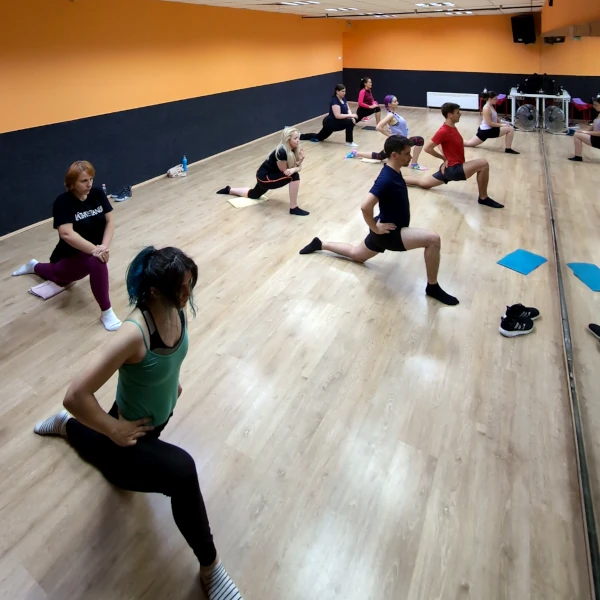
Hearing the name "Dance Workout," many people associate it with a looser, light dance class. However, what I offer is much more and more intense than that! This is a complex workout experience that you can do right in your living room. Although the foundation is provided by music and rhythm, Dance Workout is actually a fast-paced cardio (cardiovascular-improving) workout built to music, strengthening targeted muscle groups, and sometimes the full body. Here, I create my own unique exercise choreography for every single song, so you are guaranteed not to get bored, while we prepare your muscles for long-term development, and your heart rate spins in the higher calorie-burning and endurance-building zone.
A 90-minute session provide the real stimulation for the body, after which the previously mentioned 48-72 hours of regeneration is the most ideal.
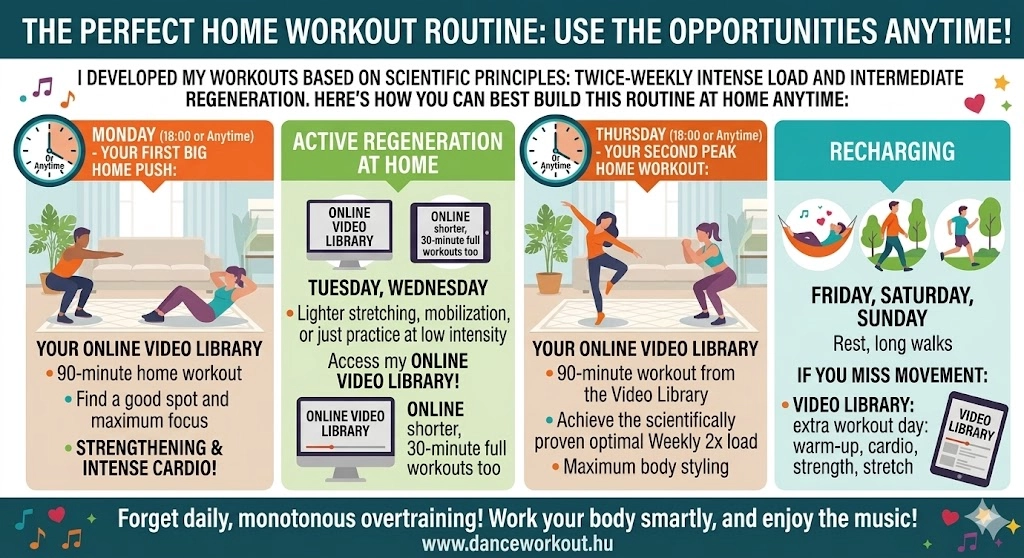
The Perfect Home Workout Routine: Use the Opportunities Anytime!
I developed my online workouts exactly around this twice-weekly, intense load and the regeneration in between. Here is how you can smartest incorporate it into your everyday life at home:
- Monday (18:00 or Anytime) - Your First Big Home Push:
Start the week with a 90-minute home workout! Find a good spot, eliminate distractions, and focus on performing the exercises correctly and safely using my online Video Library App. The focus is on strengthening and intense cardio! - Tuesday, Wednesday - Active Regeneration at Home:
After your first big push, the muscles need rest, but active resting is much better than lying inactive. On these days, log into the online Video Library App! Here you will also find shorter, 30-minute full workouts, but at this time it is better to choose a lighter stretching or mobilization routine, or just practice the steps at a low intensity. - Thursday (18:00 or Anytime) - Your Second Peak Home Workout:
The rest period is over, your body is ready for the load again! Bring on your second 90-minute workout from the online Video Library App. With this, you fulfill the scientifically proven optimal 2x weekly load, allowing you to get the most out of body shaping right from home. - Friday, Saturday, Sunday - Recharging:
Rest on the weekend, take long walks, and if you miss moving, you can also schedule an extra stretching or cardio day at home with the more fast-paced 30-minute materials found in the Video Library.
Forget everyday, monotonous overtraining! Work your body smartly, enjoy the music, and let yourself take shape and get stronger according to the rules of physiology. I look forward to seeing you in the online space!
Sources used:
Works cited:
- Workout frequency the most important factor in strength gains for women - UNSW, accessed: March 26, 2026, https://www.unsw.edu.au/newsroom/news/2019/12/workout-frequency-the-most-important-factor-in-strength-gains-fo
- Effects of dance interventions on brain health for older adults with cognitive impairment: an umbrella review - PMC, accessed: March 26, 2026, https://pmc.ncbi.nlm.nih.gov/articles/PMC12587612/] (Link: https://pmc.ncbi.nlm.nih.gov/articles/PMC12587612/




 English (Angol)
 Magyar (Hungarian)