Why does weight loss stall? The trap of starvation and hormones (Calorie Calculator)
The foundation of weight loss is undeniably a calorie deficit (energy shortage). A comprehensive 2018 clinical trial (the DIETFITS study) also confirmed: whether you follow a low-fat or low-carb diet, the calorie deficit is the deciding factor for the extent of weight loss. For a safe and sustainable pace, a daily reduction of 300-500 calories is recommended compared to your maintenance energy needs, which results in approximately 0.3 - 0.5 kg of healthy weight loss per week.
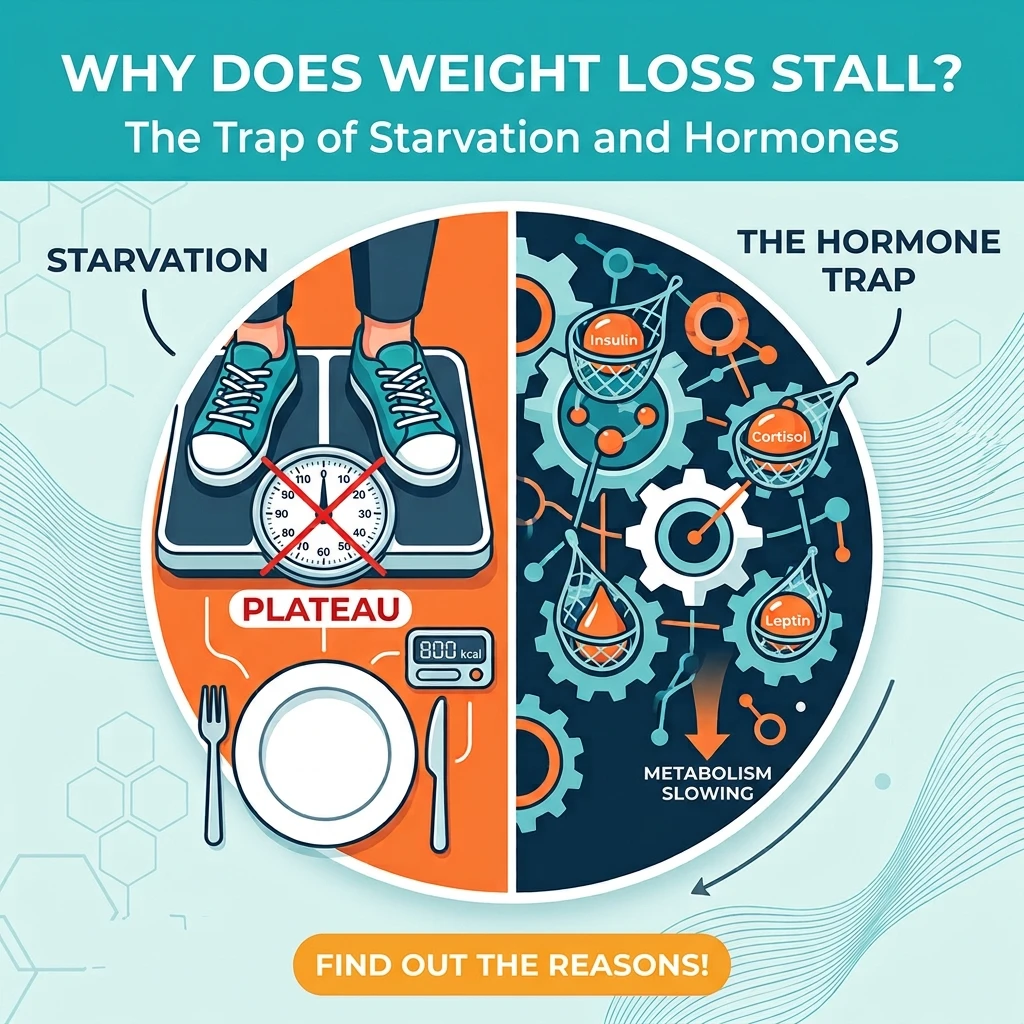
But what happens if we get impatient, overdo it, and start a drastic, 800-1000 calorie-a-day "crash diet"?
Before we dive into this, it's important to clarify: the boundary of starvation means something different for everyone! This depends on gender, height, body weight, and daily activity. Many people don't know where their basal metabolic rate (BMR) lies—that is, the amount of calories our body burns in a completely resting state just to keep our internal organs functioning.
Let's look at three real-life examples of what is considered ideal for losing 0.5 kg a week for different people, and what their BMR is:
| Gender / Age | Height / Weight | Lifestyle, Activity | Maintenance Calories (approx.) | Ideal Weight Loss (0.5 kg/week) | Basal Metabolic Rate (BMR) |
| Woman, 35 years | 165 cm / 75 kg | Sedentary job, 1-2 workouts/week | ~1900 kcal | ~1400 kcal | ~1400 kcal |
| Man, 40 years | 180 cm / 100 kg | Sedentary job, 3 workouts/week | ~2700 kcal | ~2200 kcal | ~1950 kcal |
| Woman, 25 years | 160 cm / 65 kg | 5 intense workouts/week | ~2300 kcal | ~1800 kcal | ~1350 kcal |
(Note: The values are for informational purposes only.)
Curious about your own numbers? Calculate them instantly!
With the help of the calculator below, you can find out in seconds what your maintenance calorie needs are, exactly how many calories are required to lose 0.5 kg per week, and where your basal metabolic rate lies.
An important golden rule: As your weight drops, your body needs less and less energy for everyday functioning. Therefore, to avoid a plateau, after every 3-5 kg lost, or if the scale hasn't moved for 2 weeks, return here and recalculate the values using your current, reduced weight!
Intelligent Goal & Calorie Calculator
This is the energy needed at rest for your organs to function. This is your borderline, don't stay below this!
This is what you burn daily including work and exercise. With this intake, you will maintain your current weight.
The golden mean of this: kg (Based on medical BMI index)
During weight loss, it is completely normal to approach or go below your BMR, for example, if you move very little. However, if you consistently and drastically drop below it (for instance, the 100 kg man trying to live on 1500 calories a day, or the athletic woman reducing her intake to 1000), you will hinder your body in other ways over the long term. Let's look at these in the following points.
Why does weight loss plateau? Does our body enter survival mode?
Sometimes we experience the scale not moving anywhere, despite maintaining a calorie deficit. There can be several reasons for this. One of the most widespread explanations is the development of "survival mode," or metabolic adaptation, which means the body tries to operate on fewer calories. While this is a proven biological process, its significance during weight loss is much more negligible than we might think.
Metabolic adaptation lowers the basal metabolic rate by less than 10%. If we examine this looking at the data of the 35-year-old woman mentioned in the table above, it turns out that her 1400 kcal BMR will decrease by a maximum of 10%, dropping to 1260 kcal at most! This maximum 10% (140 kcal) BMR drop is negligible when combined with exercise and a steady daily target of a 500 kcal deficit.
If weight loss plateaus, there are usually other things behind it. Often, in response to stress, the body retains water and stool, the weight of which still shows on the scale, even though fat continues to leave the body just like before. You shouldn't give up here, because as the stress on the body gradually decreases, the retained water will be eliminated, and body weight will start to drop again. If you have been dieting for a while and have successfully lost 5-10 kg, it is worth recalculating your daily maintenance calories, because as your weight changes, this also shifts.
What if you want to build muscle?
Although the focus of our article is weight loss, it's important to note: if your goal isn't losing weight, but toning up and increasing muscle mass, you need the exact opposite! In this case, you should increase your maintenance calories (TDEE) by roughly 150-300 calories, so your body has fuel to build new muscle tissue in response to workouts. However, those whose focus remains on weight loss can still build muscle while in a calorie deficit with proper strength training; for them, it's simply recommended not to maintain a deficit larger than 500 kcal. With a drastic 1000 kcal deficit, muscle building is harder, though of course, this also depends on individual metrics. An extremely overweight person (e.g., 50 kg overweight) does not need to worry about maintaining a more extreme calorie deficit.
If you would like to read more about working out, you can do so in The Ideal Workout: How Much, When, and How? Tips for Your Best Shape article.






 English (Angol)
 Magyar (Hungarian)